Since its founding in 1978, Swiss audio manufacturer Goldmund has built a reputation for exquisitely designed, high-performing and extremely costly equipment. Nearing half a century in business, the company continues to position its products as alternatives to jewellery, art and other luxuries aimed at the very wealthy.
Its latest flagship, the Mimesis Statement analog preamplifier, was shown to a Wired writer invited to the company's headquarters in Geneva. The writer described the building, with its high ceilings, concrete and glass, and meticulous tidiness, as resembling the lair of a Bond villain who had chosen audio pleasure over world domination.
In a conventional stereo setup, a preamplifier receives low-level signals from source equipment, manages volume and input selection, and passes a clean signal to a power amplifier that drives the speakers. Most listeners use an integrated amplifier that combines both functions in one unit. Enthusiasts seeking more often split the two roles into separate boxes to shield the signal from electrical interference.
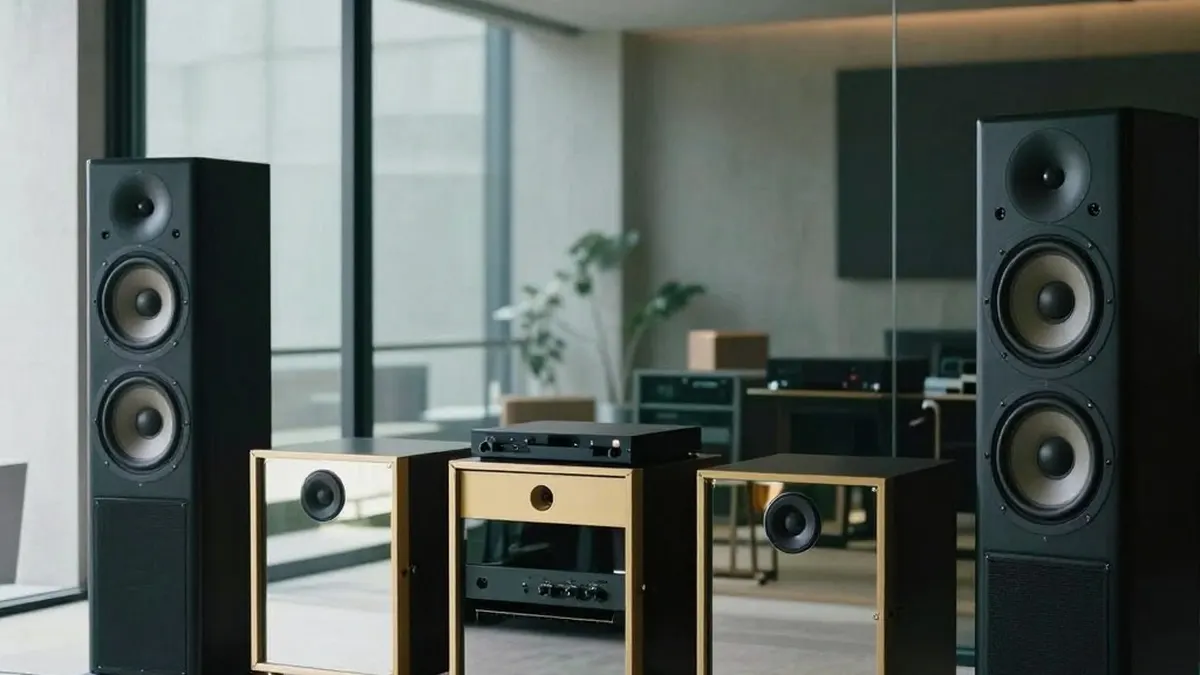
Goldmund goes further, spreading the preamplifier itself across three boxes. The first holds the buttons, dials, display and pre-amplification electronics, along with a wide range of balanced and unbalanced inputs for turntables, network streamers and other sources. The other two are external power supplies, one for each stereo channel.
The company says this separation, together with a fully symmetrical internal layout, voltage regulation stages and optimized heat dissipation, ensures signal integrity and consistent operating conditions in all circumstances. The unit's total harmonic distortion is listed at 0.0002 percent, a figure that is very hard to measure. The three chassis also feature mirrored-glass displays, metal-coated controls and Goldmund's slender gold-line design signature.
In the United States the Mimesis Statement costs $240,000, a price the writer compared to that of a fairly fancy European sports car. A preamplifier cannot make sound on its own, however. During the listening session it was paired with the Eidos network streamer ($27,000), two Thelos 9800 power amplifiers, and a pair of Theia Passive four-way floor-standing loudspeakers ($215,000 for the pair).
Each Thelos 9800 weighs nearly 800 pounds, delivers 1,560 watts per channel and costs $500,000. The complete system comes to $1,482,000, which the writer said was closer to a very nice apartment, probably with a balcony, than to a sports car. Cables were not included in that total.
The money buys a distinctive industrial design, painstaking fit and finish, hand-soldered circuit boards and military-grade alloys worked with Swiss watchmaking techniques. The writer likened the physical presence to equipment built at NASA.
Asked whether a stereo can be worth $1.5 million, the writer answered that it cannot. Having helped appraise audio gear for over two decades, the writer noted that diminishing returns set in well before six figures. Goldmund, in this view, is no more selling a hi-fi than Rolex is selling a wristwatch; it is selling status, exclusivity and what it sincerely considers the pinnacle of artisanal engineering.
It is also selling detailed, insightful and eloquent sound. The writer said that although not a prospective customer, they might become one with the disposable income.