The total solar eclipse of Aug. 2, 2027, will put some of the world's most celebrated ancient sites in the moon's shadow. Lasting 6 minutes 23 seconds at its peak, it will be the longest totality on land in the 21st century and the longest anywhere until 2114. Its point of greatest eclipse falls a few miles from Thebes, the capital of Egypt's Middle Kingdom and New Kingdom.
Modern Luxor, home to 285,000 people, is expected to become a focal point for eclipse watchers, with many thousands of international visitors anticipated. Forecasts show a 0% chance of clouds, and travelers are expected to pair the event with tours of the area's temples and monuments. On the Nile's east bank sit the Karnak and Luxor temple complexes; the west bank holds the Valley of the Kings and the Temple of Hatshepsut.
Seeing totality from inside a major temple is probably a long shot, though. Visitors are advised to prepare for extreme August heat and to confirm official opening and access arrangements before planning to watch from any archaeological site. Certified eclipse glasses are essential during the partial phases, and only during totality is it safe to look at the sun without them.
Not all of Egypt will see a total eclipse. The Pyramids at Giza, near Cairo, lie north of the path and will see a 95% partial eclipse, while Abu Simbel, south of Aswan, will see a 92% partial eclipse. The path of totality is 160 miles (257 kilometers) wide. Times and cloud-cover data cited here come from Time and Date.
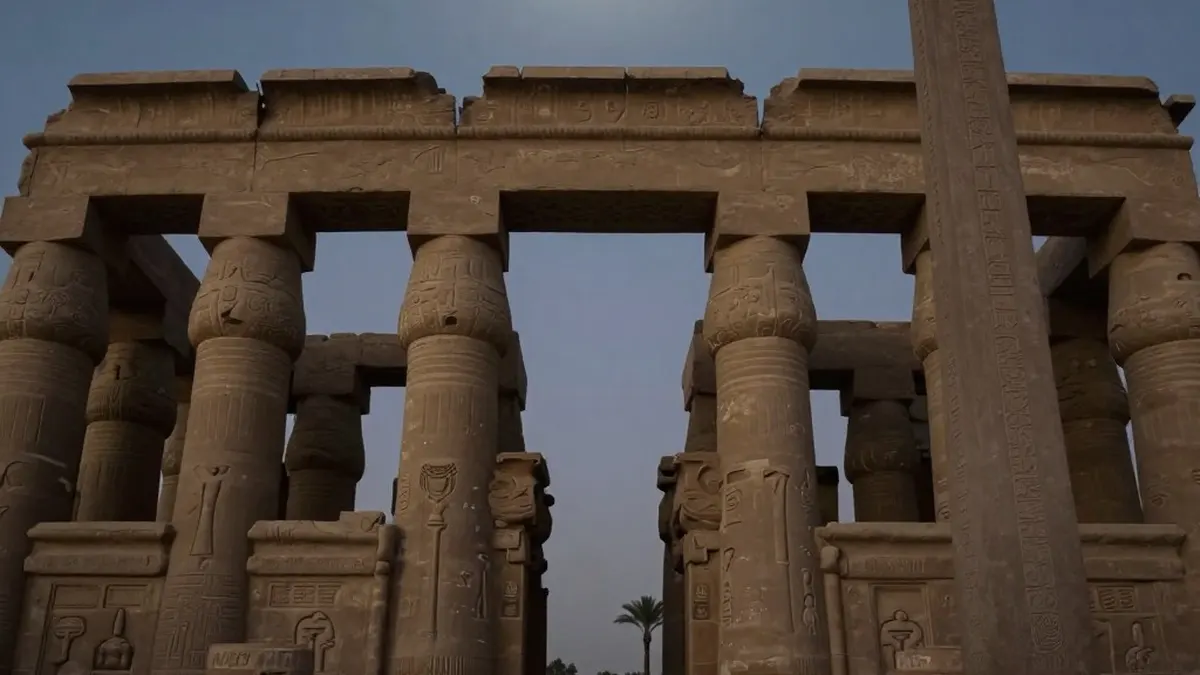
At Karnak, dedicated to Amun-Ra, totality begins at 1:02 p.m. EEST and lasts 6 minutes 19 seconds. The complex was designed by ancient astronomers, and the winter solstice sunrise still lights its innermost sanctuary. Eclipse-day access has not yet been confirmed. Luxor Temple, near the city center, has the same timing. A 75-foot (23-meter) obelisk at its entrance will point toward the eclipsed sun almost directly overhead; its missing counterpart stands in the Place de la Concorde in Paris.
On the west bank, the Valley of the Kings, the Mortuary Temple of Hatshepsut and the Colossi of Memnon all see totality beginning at 1:01 p.m. for 6 minutes 19 seconds. Tomb KV9, of Ramesses V and VI, has a ceiling in Corridor G that may depict a deep partial solar eclipse from 1143 BC. Hatshepsut's temple is vast and open-air but offers almost no shade, making it potentially the least practical choice. The Colossi are statues of Amenhotep III, with the ruins of the Theban Necropolis's largest temple behind them.
Two other west-bank sites, Medinet Habu and the Ramesseum, share that timing and are likely to be quieter. Medinet Habu is the mortuary temple of Ramesses III, with towering columns and colorful reliefs about 3,200 years old. The Ramesseum, built for Ramesses II, contains the remains of a fallen colossal statue said to have inspired Shelley's poem Ozymandias.
Those wanting to avoid the Luxor crowds have other options. The Temple of Khnum in Esna, about 34 miles (55 kilometers) south, gets 5 minutes 47 seconds of totality from 1:02 p.m., and its Hypostyle Hall sits below street level, which could offer shade. The Temple of Dendera in Qena, 40 miles (65 km) north, is dedicated to Hathor and sees 6 minutes 15 seconds. The Temple of Horus in Edfu, about 68 miles (110 km) south, gets 5 minutes 20 seconds beginning at 1:04 p.m., and its intact stone roofs provide shade.