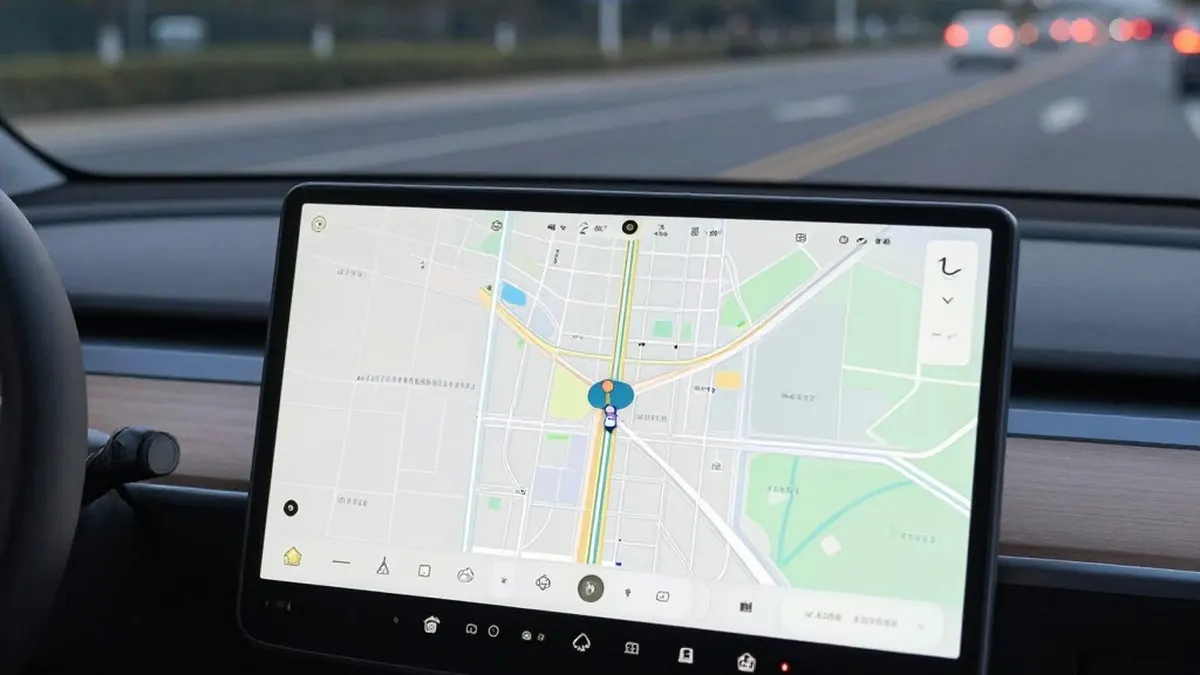
Tesla is developing its own maps to address some of the most persistent shortcomings of its Full Self-Driving system, including reading speed limits, handling parking and selecting routes. The company's head of AI outlined the plan during its third-quarter 2026 earnings call.
The topic arose in the shareholder Q&A, where a retail investor said mapping "continues to be a problem" for FSD. The investor named speed limits, parking and typical routes as the three biggest trouble spots and asked why Tesla depends on third-party maps rather than its own.
Ashok Elluswamy, Tesla's VP of AI, agreed that "we shouldn't be depending on external people's maps." He said Tesla is building a new AI-based mapping and navigation architecture that draws on what the fleet collectively learns. The system, he said, will also pick up individual drivers' preferences and respond to voice commands.
According to Elluswamy, the technology will begin handling the start and end of trips with FSD v15. Over the months that follow, it is expected to take over navigation, parking and destination handling.
The move marks a change of tone for the company. When Tesla launched Autopilot in 2015, it told Fortune it had begun building high-precision maps with "100 times the level of granularity" of standard navigation, using data from customer cars. By its Autonomy Day in 2019, however, Elon Musk described high-precision lane maps as "a huge mistake" and a "really bad idea" that makes a self-driving system "extremely brittle." In the same presentation he called lidar a "fool's errand," and the message was that Tesla would solve driving with cameras and AI alone, anywhere.
Electrek notes that the new effort is not an HD map in the sense Musk criticized, and that Tesla has always used navigation maps, so building its own is not a contradiction in itself. But the problems it aims to fix concern understanding the environment, an area where FSD still often fails, particularly with speed limit signs.
Last month, a Belgian road safety group found that FSD sped in 55% of the 30 km/h zones it tested in Brussels, averaging 44 km/h, partly because the car's screen showed a 50 km/h limit in most of them. In the United States, NHTSA is weighing an investigation into claims that Tesla Robotaxis speed through active school zones, covering about 1,000 Model Y and Cybercab vehicles.
The approach also resembles Waymo's, which maps a city with sensor-equipped vehicles before launching service and updates those maps as its fleet drives. Tesla is now describing a similar loop, in which its cars collect data that feeds a Tesla-built map for every vehicle. The main difference, Electrek says, is that Waymo's cars carry lidar. The plan also fits Tesla's Robotaxi service, which operates city by city within small geofenced areas.
Electrek's view is that using maps is reasonable and that a map built from millions of Tesla cars could be a real advantage, particularly if it fixes the speed limit problems. Its criticism is aimed at the years of messaging that Tesla's approach did not need maps. The outlet also noted that Tesla has pushed unsupervised FSD in customer cars to Q2 2027, and only inside its Robotaxi fleet.