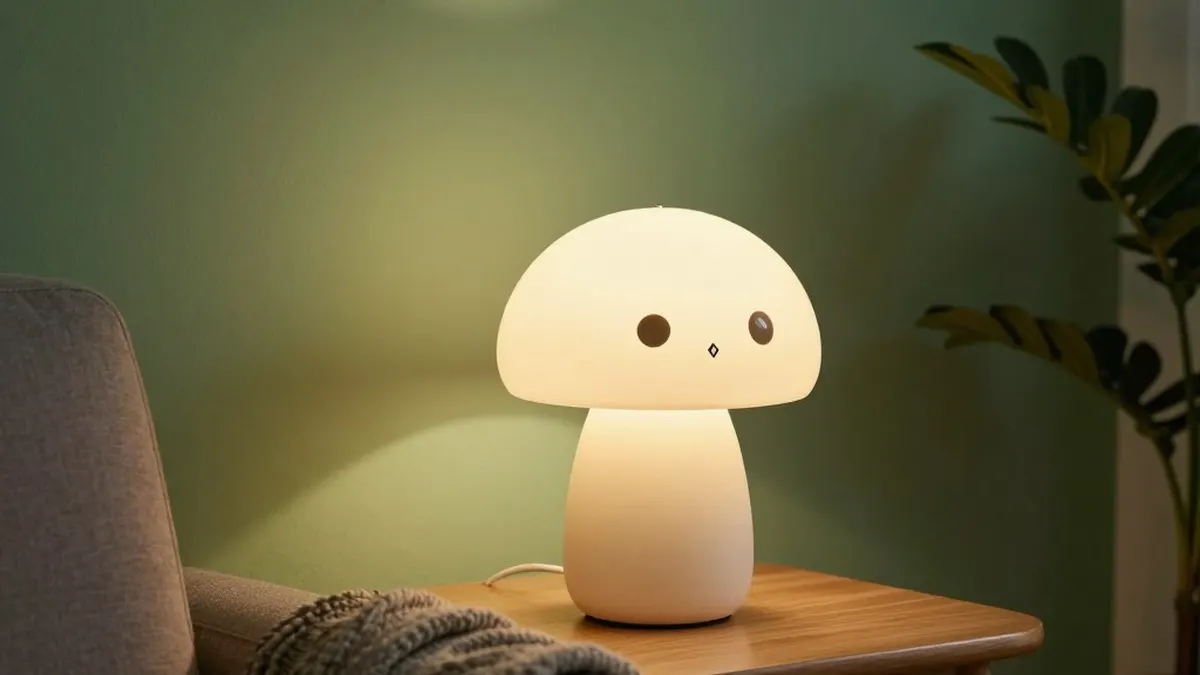
A new startup is betting that consumers will pay hundreds of dollars for a home robot that does very little on purpose. OKA, short for One Kind Artifact, has introduced Mori, a mushroom-shaped lamp that reacts to its surroundings but does not take commands, answer questions or run a smart home.
Mori stands nearly 12 inches tall. When it detects someone entering a room through its microphone, its head lifts to reveal animated eyes and a small diamond-shaped nose that houses a camera. It follows people as they move, makes soft chirps the company's pitch compares to a mix of a bird and R2-D2, and jiggles when it sees its owner return. Touching its head makes the eyes and camera retract, turning it back into an ordinary lamp that plays nature soundscapes.
OKA is based in Cambridge, Massachusetts, and Shenzhen, China, and focuses on experimental technology. CEO Hua Wang told WIRED he plans to make five such "Artifacts" over the company's lifetime, with Mori the first. Before cofounding OKA, Wang was a general manager at Meipai, a video-sharing app from Chinese phone brand Meitu, and cofounded Bondee, a social app that briefly went viral in Asia and is now defunct.
According to the company, the goal is to reconnect people with nature. Mori glows in colors inspired by rain, forests, fire and wind, responds to movement, and can lead a calming breathing session. It can also dance to music or to action on a television, and it jiggles if asked how an outfit looks. Unlike an Amazon Echo, it cannot control smart lights, cue up Spotify or give a weather forecast.
OKA says its "Attentive Intelligence," powered by several local large language models, lets Mori read a room through its camera and microphone to decide when to engage and when to stay quiet. It remembers people and may act shyer around guests, and it forgets someone it has not seen for a month. It might try to draw a person away from two hours of phone scrolling, but goes silent during a phone call or an argument. "All gadgets try to capture more of your attention," Wang said. "Mori gives your attention back to you."
On privacy, Wang said Mori connects to Wi-Fi only for firmware updates. Raw images and audio are processed on the device and then discarded, and facial feature data used to tell owners from guests is encrypted locally and never uploaded. The camera shuts off when the robot retracts, and double-tapping its head turns off the microphone. The device is battery-powered and can also stay plugged in.
Pricing is steep. A Founder's Edition costs $649, with stock limited to a few hundred units, and includes a two-year warranty and two years of the subscription service, which otherwise runs $17 a month or $80 a year. The standard edition costs $849, with a $799 preorder price, and does not include subscription features. Breathing exercises are free, but the nature soundscapes require a subscription.
Wang said the skill set is limited for now and could grow, possibly to include Oura Ring data, Spotify access or voice commands. He described the target audience as younger people rather than the elderly or children, noting that many leave a television on to fill an empty room.
Chris Harrison, director of the Future Interfaces Group at Carnegie Mellon University, pointed to Sony's 1999 Aibo as an early digital companion, but said such devices lacked what artificial intelligence now offers. Asked about Mori's modest abilities, he compared it to owning a goldfish or hamster and asked whether it was being held to "an unrealistic bar." Whether buyers will pay for a robotic pet that cannot fetch or tell the time remains an open question.