Nvidia chief executive Jensen Huang laid out his vision for Europe's technological future at the company's GTC conference in Berlin on Wednesday. It rests on robotics, AI agents and modular data centers, all running on Nvidia hardware. "To be part of this AI economy, you don't want to just be consuming the AI. You want to be producing the AI," he told an audience of around 4,000. "We can do all of that here in Europe."
The priorities differed markedly from the previous GTC, held in San Jose, California, in March, which centered on AI inference and more efficient computing. Seven months on, the emphasis has moved to power, agents and physical AI. The 90-minute keynote closed with small Microduck robots, built by Hugging Face, a recent Nvidia acquisition, carrying out Huang's instructions on stage.
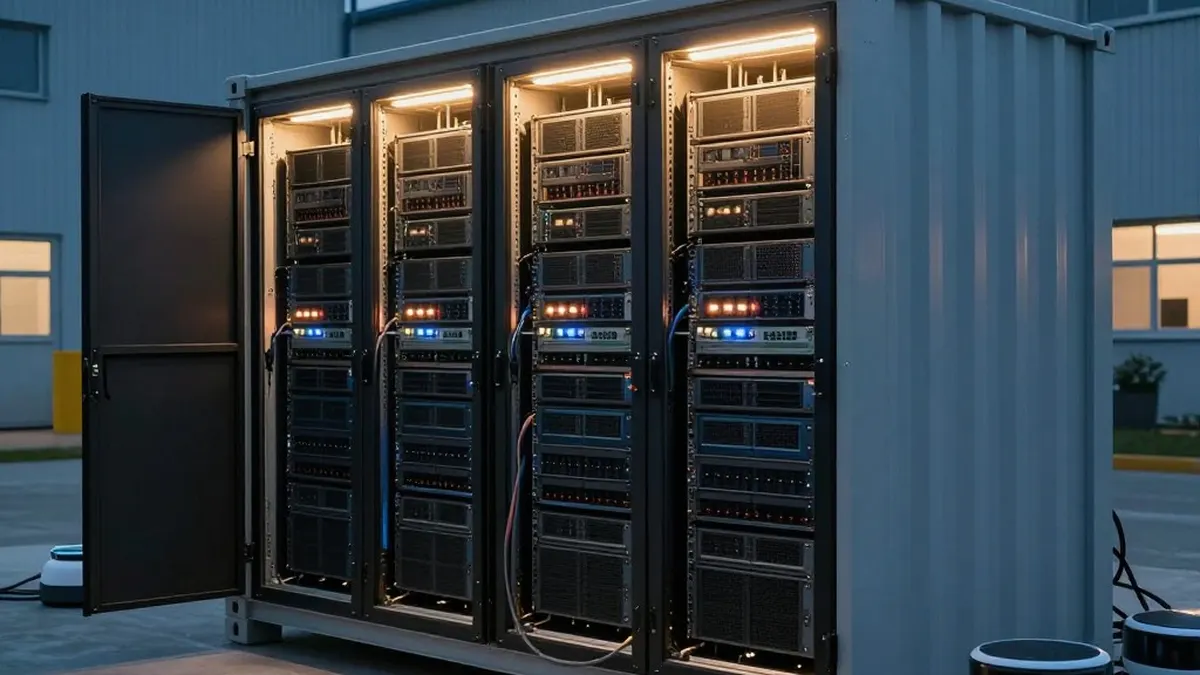
The headline announcement was the DSX Pod, a modular "AI factory" designed as a plug-and-play way to build AI data centers. It arrives pre-assembled in a large metal container and is loaded with Nvidia's latest Vera Rubin compute racks. According to Huang, it can be operational in 14 days, compared with the months or years that conventional construction can take. That could be especially relevant in Europe, where infrastructure projects are notoriously slow. Huang added that faster deployment would cut the time computing capacity sits idle. "This is a complete transformation," he said.
The talk took place at Berlin's Tempodrom, a venue inspired by a circus tent and lit like a gamer's den. It moved between consumer products such as laptops and sweeping forecasts, with Nvidia cast as the core technology supplier to every industry. At one point two Greenpeace protesters stood and unfurled a banner reading "Clean up your dirty business." As they were escorted out, Huang told his security team to "Go easy."
Huang called humanoid robotics the "next great industry" and said Europe's manufacturing heritage leaves it well placed to lead. He stressed that physical AI extends well beyond robots, noting that even telecom operators are adding Nvidia GPUs to their cell towers. He also announced partnerships with European carmakers Volkswagen and Mercedes on autonomous vehicles.
On the robotics side, Nvidia is launching a full-stack platform meant to standardize configuration. It also plans to release a preconfigured reference robot, Agile One, in the first quarter of next year to help developers begin building physical AI systems. "This is your great opportunity," Huang said.
Turning to AI models, Huang predicted that "every company in the future will use both closed models as well as open models that you customize." He presented Nvidia's own open-source models as reaching frontier-level performance once tailored to an organization's proprietary data.
He also forecast that AI agents will make software tools more widely used than ever. Their reasoning, iteration and tool use, he said, are driving up token consumption and the demand for computing power, and with it for Nvidia GPUs.
The keynote ended with an AI-generated Eurovision-style song recapping the announcements.