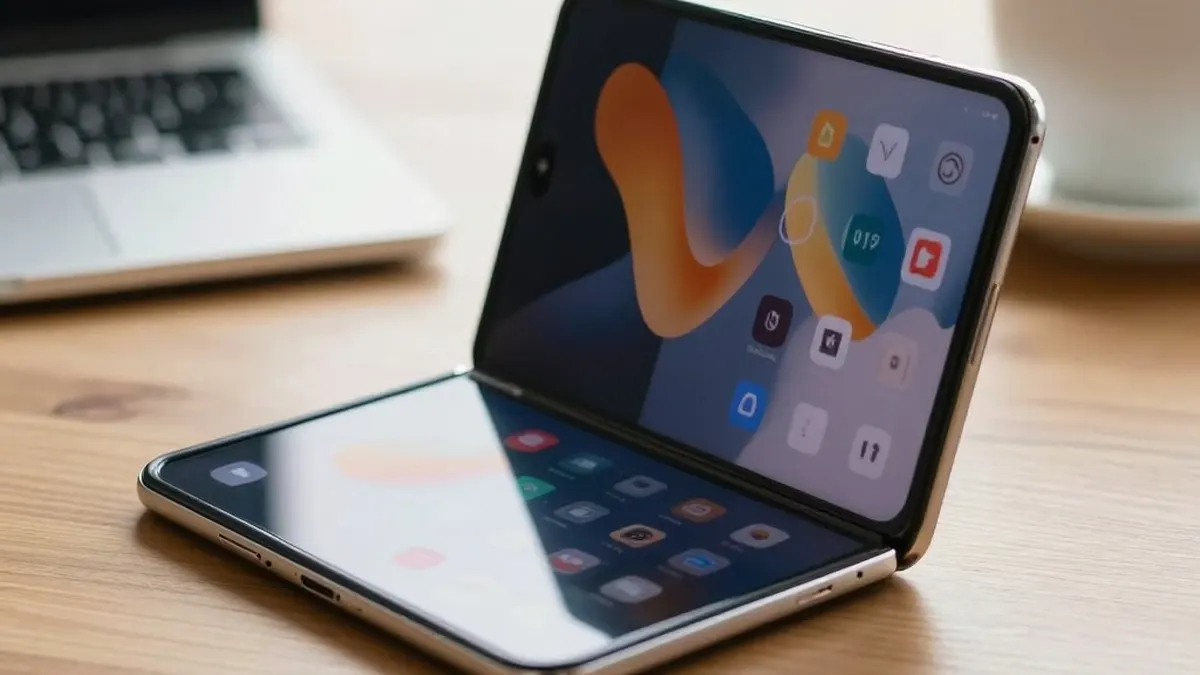
Early reviews of Apple's iPhone Duo are in, and despite the divisive reputation of foldable phones, critics have reached a surprising degree of agreement. Most call it the best foldable currently available, yet few suggest it is right for everyone. The 9to5Mac review concluded that the form factor "represents the future of the iPhone," while acknowledging the compromises of a first-generation device.
Five themes recur across the coverage. The Duo is judged the strongest foldable on the market, suggesting Apple's long wait to enter the category paid off. It is not for every buyer, however. Beyond the high price, reviewers say people who mostly use the outer screen and unfold the phone only a few times a day will find the weight in one hand and the unusual display shape hard to accept.
The crease is the third point of agreement. Apple has not made it invisible and has not claimed to. It can be seen at certain angles in certain light and felt under a fingertip. Reviewers nonetheless describe it as the least intrusive on any foldable and say it is not a problem in everyday use. The nano-texture display, which also cuts outdoor glare, was credited with helping to minimize it, though one reviewer noted it costs perfect blacks and some color saturation compared with the iPhone 18 Pro Max.
Software maturity is the fourth concern. Many third-party apps have yet to be updated, and in the worst cases an iPhone-style layout sits in the middle of a mostly black inner screen. Reviewers expect that to improve quickly, but say early adopters should anticipate disappointments. The fifth is the return to Touch ID. After a week of testing, most reviewers said they had not gotten used to it and would prefer Face ID. Several also lamented the lack of a telephoto camera on a $2,000 phone.
Two testers put the hardware through repeated folding. Joanna Stern's tests found the hinge changed over tens of thousands of folds, becoming stiffer rather than looser. The change was measurable with a strain gauge after 32,000 folds, but she could not feel it in normal use. HTX Studio measured the crease at just 48 microns deep when new, about half the thickness of a sheet of paper, with a slope under 0.1 degrees, both better than rival foldables. After 3,000 folds the depth rose to 167 microns and the slope to 1.24 degrees, bringing it in line with other foldables after the same number of folds.
Verdicts on the bigger picture varied. One reviewer called the Duo one of the most early-adopter Apple products tested in a long time, but expected a second generation to be lighter and to add Face ID, a better inner camera, a telephoto lens and a lower price. A more skeptical critic argued that the two screens' aspect ratios work against each other, leaving a makeshift phone outside and a cut-down tablet inside, and that the benefits are occasional while the costs of weight, battery life and price are constant. That reviewer described the outer screen as the worst iPhone experience ever and the device as an "extraordinarily polished prototype."
Others were warmer. CNET said Apple appeared to have "stuck the landing" and produced a cohesive, intuitive and useful foldable, while doubting that broader appeal is near because most people do not need a phone that doubles as a tablet. Another reviewer said the Duo had generated more buzz for foldables than rivals managed in seven years, and a further assessment called the category here to stay.
One comparison drew attention: Android foldables often lack a compelling reason to open their inner screens, whereas the Duo's outer screen is not useful enough, so users want to open it constantly. The ideal, that reviewer said, lies somewhere in the middle. The Duo is backordered for many buyers until December or January, which one reviewer noted should give developers time to update their apps.