
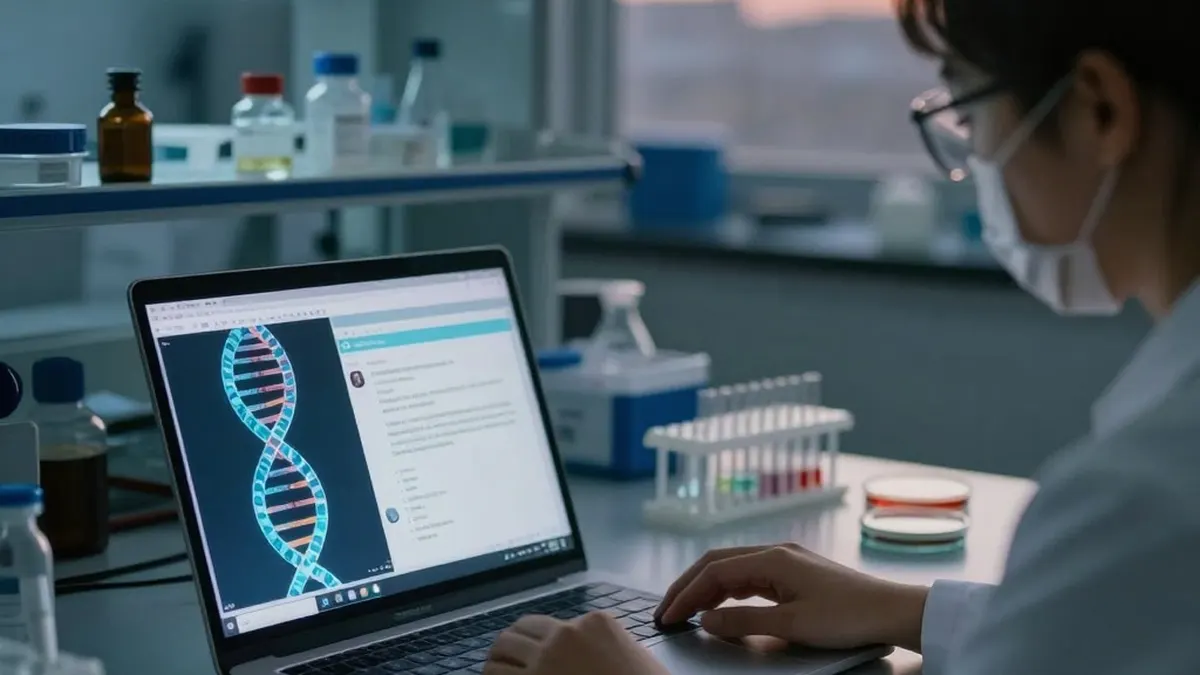
Hugging Face, the AI platform, on Thursday (2026-10-22) released an open model designed to help people interpret DNA, and it is small enough to run locally on a laptop. The model, called Carbon-X, was developed with researchers at Zhongguancun Academy in China and the University of Naples Federico II in Italy.
Carbon-X was trained on both genomic sequences and natural language, so users can pose questions about how changes in DNA affect gene activity and health and receive conversational answers. Lewis Tunstall, a senior research scientist at Hugging Face, said the tool is intended to help researchers design new drugs and genetic therapies, and could potentially help patients make sense of their own genomes.
"We've unlocked a new capability in language models, which is fundamentally about being able to chat with DNA," Tunstall said. He added that the natural-language approach means even nontechnical users "can actually ask questions about DNA that wouldn't be accessible through any other tool."
Hugging Face is often described as essentially GitHub for AI models. It hosts a library of ready-made tools and a platform for running mostly open-weight and open-source AI applications. In September, Nvidia agreed to acquire the company for nearly $13 billion. Hugging Face was also at the center of a major hack by OpenAI's models earlier this year.
DNA resembles computer code more than human language, using the letters A, C, G and T where computers use 0s and 1s. A human genome contains 6 billion of these letters. Although the genome has been sequenced from end to end, scientists still do not understand how most of it works.
AI models are increasingly being used to probe those mysteries. Google DeepMind released AlphaGenome last year, which predicts the effects of DNA sequences and mutations but delivers results in numeric form and demands more computing power. Evo 2, built by the Arc Institute and Nvidia with academic partners, speaks the language of DNA and can generate entire genomes from scratch. Carbon-X, by contrast, combines DNA and natural language in a conversational interface, much like a ChatGPT for DNA.
To build it, the team began with an existing language model and expanded its vocabulary so it could read DNA in groups of six letters. They then continued training on 300 billion tokens combining DNA sequences, English text and examples linking DNA to biological descriptions. The sequences came from mammals, including humans, as well as other vertebrates, invertebrates, plants, fungi and protozoa. Tunstall said viruses were left out because the team did not want the model used for potentially dangerous applications.
The model has limits. It was trained to handle DNA sequences of roughly 50,000 base pairs, so users cannot upload full human genomes and can only query small portions at a time. One use Tunstall points to is helping scientists judge whether a mutation is benign or disease-causing, a key step in developing targeted treatments, since an intervention aimed at the wrong mutation could be ineffective or cause unintended harm.
Because researchers face restrictions on uploading identifiable or sensitive patient data to frontier AI models, the team deliberately kept Carbon-X small, at 14 billion parameters, so it can run on a user's own hardware rather than in the cloud. Tunstall said no data is sent to Hugging Face or any other company. The developers cautioned, however, that they have not validated the model with actual wet lab experiments, so they cannot say how accurate its predictions are.