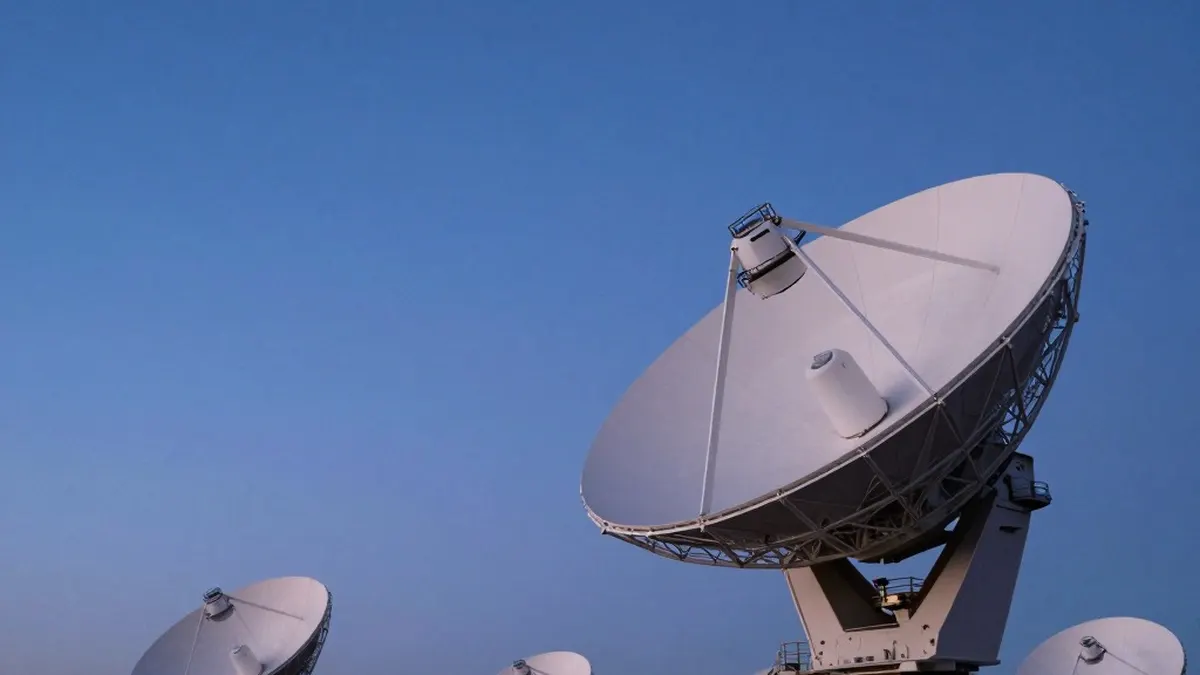
Global revenues from satellite services are expected to rise 44% to reach $145 billion by 2035, according to the 33rd edition of Novaspace's Satellite Connectivity and Video Market report, released in Paris in October 2026. The consultancy describes the coming decade as a fundamental shift for the industry, with data services taking over as the main engine of growth.
Novaspace forecasts that data services will account for 68% of total satellite services revenues by 2035, up from 26% at present, with revenues from this segment approaching $100 billion. Demand for connectivity is rising across consumer, defense, government and enterprise markets. Video remains the largest revenue segment today, but the report says future expansion will come from connectivity.
Three segments are expected to lead that expansion. Consumer Broadband, Milsatcom and Enterprise Networks are projected to add $22.6 billion, $19.2 billion and $17.2 billion in revenues, respectively, over the next ten years. Milsatcom is singled out as a particularly important driver, supported by rising defense spending and wider adoption of satcom-enabled operational concepts among military forces. Non-geostationary (NGSO) constellations are also becoming a more important source of resilient capacity for government and defense users.
"Satellite connectivity is moving firmly into the mainstream," said Dimitri Buchs, Project Manager and Editor of the report. He pointed to the rapid growth of NGSO capacity, falling bandwidth costs and rising demand for resilient, always-available connectivity as factors that are "fundamentally changing where and how satellite communications compete."
The satellite capacity market is forecast to exceed $46 billion by 2035, more than three times its 2025 level. Video Distribution, the largest capacity segment in 2025, is expected to make up only 3% of capacity revenues by 2035. Consumer Broadband and Milsatcom together are projected to represent more than half of total capacity revenues.
Lower bandwidth costs, driven by high-throughput satellite (HTS) systems and a growing number of NGSO projects, are pushing satellite connectivity into mass-market uses. Providers such as Starlink are increasingly competing with terrestrial broadband on price, which strengthens satellite broadband as an alternative to fiber and wireless services in a widening range of markets.
The shift is also changing the role of geostationary (GEO) operators. Commercial GEO orders fell to a low of six in 2024, then recovered to 10 in 2025, with another 14 recorded by mid-September 2026. Novaspace attributes the renewed activity to evolving multi-orbit strategies and continued demand for GEO capabilities alongside fast-growing NGSO systems.
Buchs cautioned that this is "not a return to the traditional GEO model." He said software-defined satellites, more flexible commercial models, sovereign requirements and multi-orbit strategies are redefining what GEO does. In his view, the future of satellite communications "will not be GEO or NGSO" but an ecosystem in which each architecture serves distinct and complementary requirements.
The latest edition covers service revenues, capacity demand, pricing trends, competitive dynamics and operator strategies across video, broadband, enterprise, mobility, government and defense markets through 2035. New to this edition are a bottom-up model for Enterprise Networks Back-up terminals and a revised commercial Milsatcom model with deeper analysis by region, frequency band and infrastructure type. The report also reviews developments such as NGSO constellation evolution, emerging Q/V frequency bands and other regulatory changes, government and defense spending trends, and the competition between satellite and terrestrial connectivity.