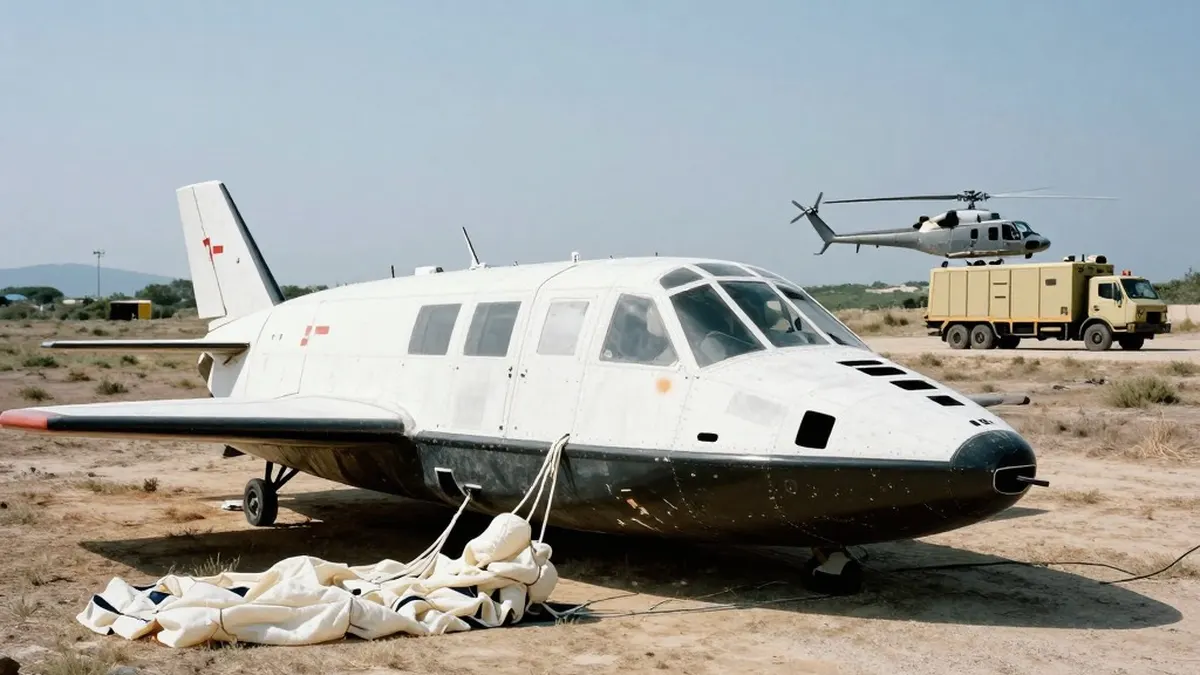
A full-scale prototype of the European Space Agency's first reusable spacecraft was destroyed in a descent test earlier this month, after its steerable parachute came loose while opening. The Oct. 6 trial of the Space Rider mockup did not go as engineers had planned.
According to ESA officials, the vehicle's first parachute, known as a drogue, opened without trouble. The larger main parafoil, however, detached as it was deploying, and the mockup was left with no means of slowing down before it hit the ground. The cause is still being investigated.
An ESA spokesperson confirmed the outcome in an email to Space.com. "Following several successful tests using representative vehicle masses, the latest system-level drop test in October was not completed as planned due to an anomaly during the parafoil deployment sequence," the spokesperson said. An independent investigation is under way to find the root cause and "inform the next steps."
Space Rider is meant to be Europe's first reusable orbital spacecraft. The uncrewed vehicle is designed to carry scientific experiments into orbit for as long as two months and then bring them back to Earth for analysis. Its return method sets it apart from any spacecraft now in operation: a wingless, lifting-body craft, it uses a steerable parafoil to guide itself toward a landing site and touch down in the manner of a runway landing. That approach is more precise than other parachute-assisted recoveries in use today.
Demonstrating that capability was the goal of the latest test, and it is a key requirement for reusing the vehicle after orbital missions. ESA nonetheless does not expect the failure to disrupt the overall timeline. Géraldine Naja, the agency's director of space transportation, said the remaining qualification tests are not what is holding up the path to launch.
"We hope that this test will not damage, or let's say lead us to modify, the remaining schedule and qualification activities," Naja said at an ESA Council media briefing on Oct. 22. "In any case, the remaining qualification activities are not on the critical path of the development of the Space Rider." She called the incident unfortunate but important, noting that "testing and validation is part of the development of a space system."
The destroyed article was a minivan-sized test model built to evaluate descent and landing systems. It matched the size and flight characteristics of Space Rider's reentry module and carried avionics for autonomous guidance and navigation, but it was not a space-ready vehicle. The test took place at a military range on the Italian island of Sardinia, where a helicopter released the mockup from about 2 miles (3 kilometers) up. ESA has since recovered all of the vehicle's components.
The October trial was the first drop test since a May attempt that was called off when a sensor flagged a problem during preparations, before the model was released. The range, operated by Italy's Ministry of Defense, was then unavailable from June through September.
The descent and landing qualification campaign began in 2025, and earlier tests successfully showed the parafoil deploying and the vehicle operating autonomously. Separately, earlier this year Space Rider's heat-shield materials were exposed to temperatures of around 2,900 degrees Fahrenheit (1,600 degrees Celsius) in plasma wind tunnel trials. ESA is aiming for the first orbital mission later this decade.