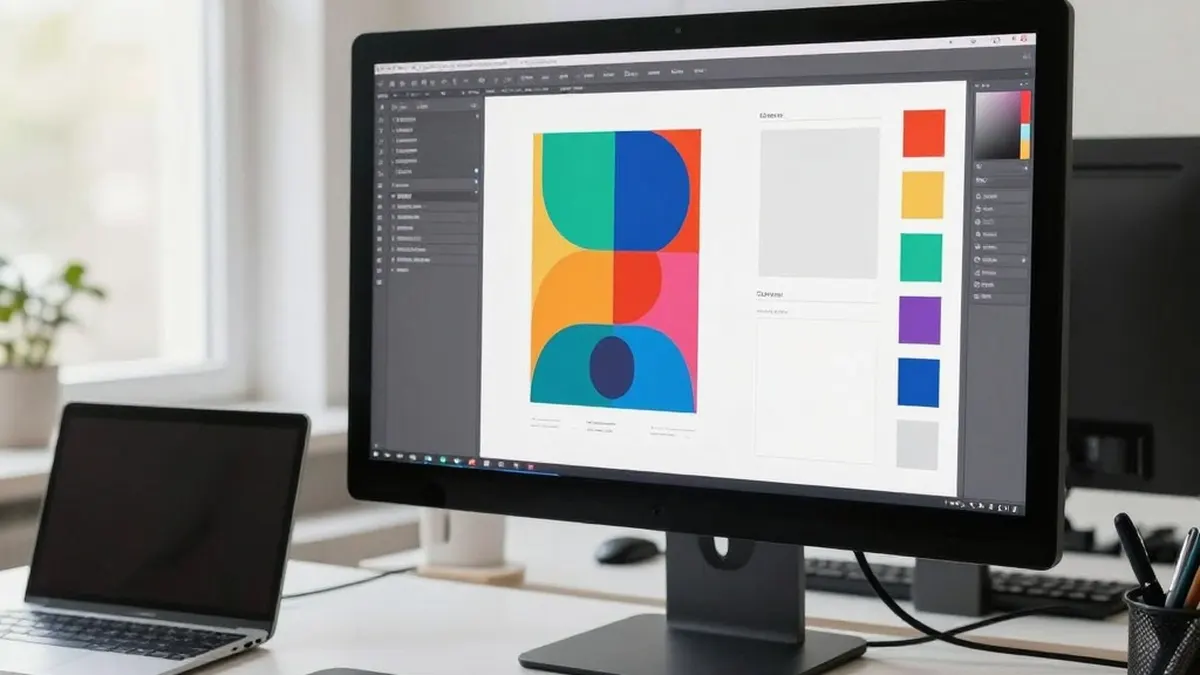
Canva has released its first image generation model, Canva Craft, built by the company's own research team. The launch puts the design platform in competition with comparable image models from Google, OpenAI, ByteDance and Meta.
According to Canva, Craft works in two stages. It first interprets a user's prompt and drafts a plan covering details such as how elements relate to one another in space, their relative scale, the visual hierarchy and the information needed to generate text. In the second stage, the model produces an image at up to 2K resolution, with around 30 aspect ratios available to suit different platforms.
The company says this approach lets the model render objects accurately and produce readable text. It also says users can make precise edits without altering other parts of the image.
Training data sets Craft apart from many rivals. Canva said it used designs rather than photographs, drawing on human-made templates from its library. These include posters, social posts, presentations, infographics, menus and layouts heavy on typography.
As a result, images created with Craft can be turned into layered designs through Canva Magic, the company's image-to-design transformer. Canva released its own model for understanding designs and layers last year.
Craft is open to all users on the platform and can be reached through the Dream Lab tab. Canva will also offer it through its API, and it plans to support image generation inside third-party chatbots such as ChatGPT and Gemini via Canva's MCP.
The platform has relied on a number of different image models for generation. A single in-house model is therefore likely to reduce API costs, though Canva said the benefits also include better quality and speed control. Researchers from Leonardo.ai, the media generation platform Canva acquired in 2024, contributed to the new model.
Canva said it is developing two cost-efficient versions, called Craftfast and Craft-ultrafast, which are due out soon.
The launch comes as the company faces pressure on its finances. Canva was on track for $4 billion in revenue last year, but it cut its growth forecast for 2026. That move reportedly caused its valuation to fall from $42 billion to $35 billion, according to external analysts.